
Rob Callaghan Chief Product Officer, Connect Tech Inc. | April 2026
The NVIDIA® Jetson AGX Orin (JAO) 64GB and the Jetson AGX Orin Industrial (JAOi) share the same System-on-Chip (SoC), connector footprint, and software stack. Selection between them is governed primarily by operating temperature floor, operational lifetime, memory integrity, or mechanical stress requirements. This brief documents where the specifications diverge and what that means for your program.
The Jetson AGX Orin is NVIDIA’s highest-performance production module for Edge AI, delivering up to 275 sparse Tera Operations Per Second (TOPS) of inferencing compute in an embedded form factor. It is deployed across robotics, autonomous vehicles, industrial automation, and aerospace and defense applications. Connect Tech Inc. (CTI) is an NVIDIA Elite Partner with over 40 years of experience in embedded computing, and has integrated both Jetson AGX Orin module variants across a full lineup of validated carrier boards and system-level platforms. The performance difference between the two modules is modest in most workloads. Where they genuinely separate is in environmental qualification, cold start behavior, operational lifetime, and manufacturing construction differences that are only relevant under specific deployment conditions.
“The 64GB is rated to –25°C (-13°F) at the Thermal Transfer Plate (TTP). That is the reliable cold start floor. The Industrial is verified at –40°C (-40°F).”
THE CORE QUESTION
The performance delta between the two modules is modest. The Jetson AGX Orin 64GB delivers 275 sparse TOPS versus 248 on the Industrial. Graphics Processing Unit (GPU) clock runs at 1.3 GHz on the 64GB versus 1.185 GHz. Combined Deep Learning Accelerator (DLA) throughput is 105 TOPS versus 92. The 64GB also supports two simultaneous 4K60 NVIDIA Video Encoder (NVENC) encode pipelines where the Industrial supports one. In controlled environments with commercial lifecycle expectations, the 64GB delivers higher peak compute and simpler carrier integration.
The Industrial module trades a measured reduction in peak compute for a different set of capabilities: SoC corner bonding and component underfill, hardware Error-Correcting Code (ECC) memory, a cold start floor of –40°C (-40°F) versus –25°C (-13°F) on the 64GB, consistent with its rated Thermal Transfer Plate (TTP) floor, 50G operational shock and 5 Grms operational vibration qualification, a 10-year operational lifetime versus five, and USA-only country of origin. The 64GB has none of them. Whether they matter is a function of the deployment.
At $1,999 USD versus $2,899 USD at 1KU+, the $900 USD delta is straightforward to evaluate once the deployment requirements are clear.
THE DECISION GATES
Criteria for module selection.
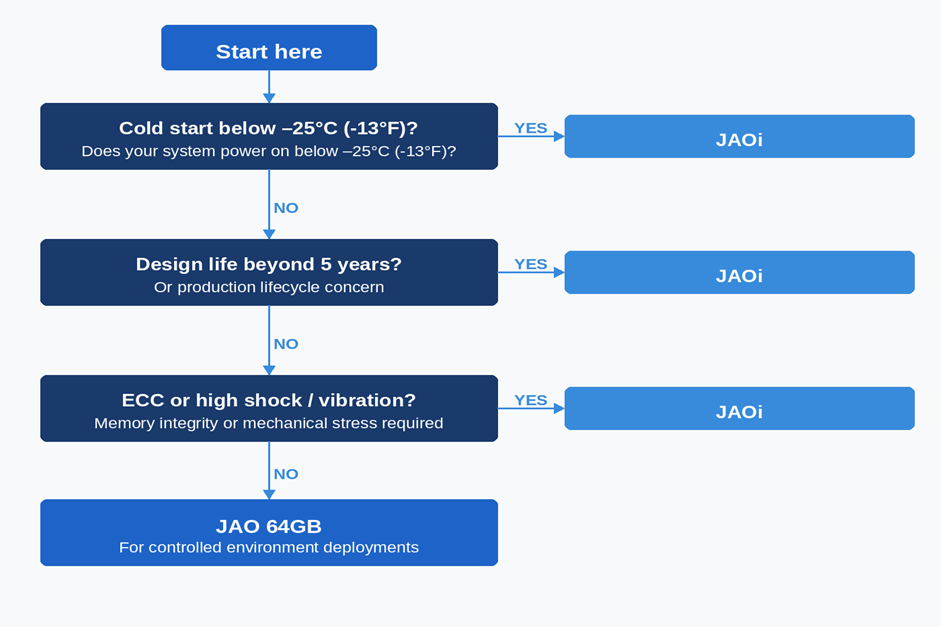
The specification table covers what differs. These questions determine whether those differences are relevant to your program:
Does your system cold start below –25°C (-13°F)?
The 64GB is rated to –25°C (-13°F) at the TTP. Our observations confirm this as the reliable cold start floor. For indoor or temperature-controlled deployments, this does not come into play. For vehicle-mounted platforms, outdoor infrastructure, or any system powering on in sub- –25°C (-13°F) ambient, it is the relevant limit. The Industrial module cold starts at –40°C (-40°F), consistent with its extended qualification envelope.
Is your design life beyond five years?
The 64GB carries a five-year 24×7 operational lifetime and production availability through 2030. The Industrial module carries ten years of rated lifetime backed by 3,000-cycle power cycling validation and 1,500 hours of high-temperature operational endurance testing, with production through 2033. For programs with commercial refresh cycles the 64GB is straightforward. For programs with 10-year design lives, the lifetime rating needs to be matched to the module.
Does your application require memory integrity or sustain high mechanical stress?
ECC memory is present on the Industrial module and absent on the 64GB. It is a hardware capability. For applications where memory integrity is a requirement, the Industrial module is the answer. On the mechanical side, both modules share 140G non-operational shock qualification. The Industrial adds 50G operational shock and 5 Grms operational vibration, tested while powered and running. The 64GB was not tested to operational shock or vibration conditions. Whether those qualifications matter depends on the deployment environment.
WHAT THE NUMBERS ACTUALLY SAY
Key specification differences sourced from published documentation and CTI field observations.
The operative comparison, sourced from NVIDIA’s published documentation and our own field observations:
| Key Specification Delta | |
|---|---|
| System TOPS | 275 (64GB) vs. 248 (Industrial) |
| GPU clock | 1.3 GHz vs. 1.185 GHz |
| DLA TOPS combined | 105 vs. 92 |
| NVENC 4K60 | 2x (64GB) vs. 1x (Industrial) |
| Cold start floor | –25°C (-13°F) (CTI observed) vs. –40°C (–40°F) |
| TTP operating range | –25°C to +80°C (-13°F to +176°F) vs. –40°C to +85°C (-40°F to +185°F) |
| Operational lifetime | 5 years vs. 10 years |
| ECC memory | No vs. Yes (hardware) |
| Underfill | None vs. SoC corner bonding + underfill |
| Operational shock | Not tested vs. 50G, 11ms |
| Operational vibration | Not tested vs. 5 Grms |
| Country of origin | China/USA/Vietnam vs. USA only |
| MSRP (1KU+) | $1,999 vs. $2,899 USD |
| Production until | 2030 vs. 2033 |
THE CTI PERSPECTIVE
CTI module selection guidance.
When evaluating these two modules with a customer, the answer is usually clear once the deployment conditions are on the table. For indoor deployments with a benign temperature range and a commercial refresh cycle, the 64GB delivers more compute, simpler carrier board integration (no dedicated SYS_VIN_SV rail required), and a $900 USD per-unit cost advantage at volume.
Where any of the three conditions apply, the Industrial module is the right specification: cold start below –25°C (–13°F), design life beyond five years, or ECC and operational shock requirements. The $900 USD premium at volume is a known quantity. The qualification coverage it provides is not available elsewhere on this silicon.
Both modules run across our full Jetson AGX Orin carrier lineup under the same Board Support Package (BSP): Forge, Rogue, Rogue-RX. The software difference is a flash path and a device tree designation. Migrating a 64GB carrier design to Industrial requires a board revision to bring pin L53 to a live 3.3V rail with correct power sequencing; this should be scoped into the program plan at the carrier design phase.
“For most programs, the 64GB covers the requirement cleanly. Where the Industrial is needed, the qualification delta is what drives the decision.”
If your program clears all three gates, the 64GB is the correct module. If any gate applies, the Industrial module is the specification. The criteria are binary; the deployment environment determines which side of the line you are on.
The full technical whitepaper covers all specification deltas, power sequencing, thermal design, Board Support Package (BSP) integration, carrier board compatibility, and a complete procurement checklist. Download it below.