
Through CTai LABS, Connect Tech helps customers right-size compute, memory, and I/O, evaluate deployment needs, and align platform strategy with the NVIDIA roadmap — reducing risk and accelerating time to market amid high memory price.
What NVIDIA announced
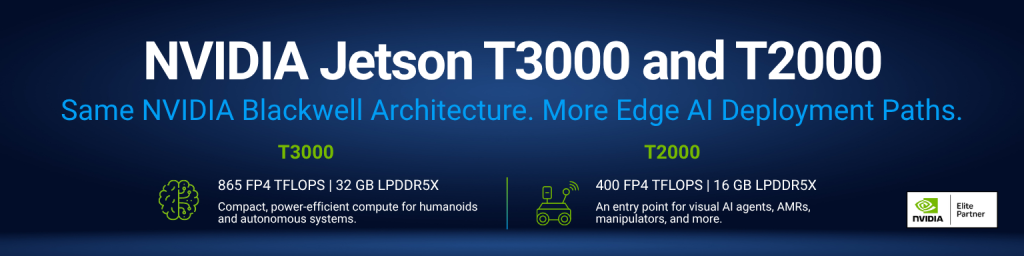
NVIDIA expanded the Jetson Thor family with the introduction of new modules aimed at scale. The Jetson T3000 pairs a Blackwell GPU delivering 865 FP4 TFLOPS with an 8-core Arm Neoverse CPU, 32 GB of LPDDR5X, 273 GB/s of memory bandwidth, and 25GbE connectivity. For deployments requiring functional safety certification, Connect Tech will support the IGX T3000 variant alongside the standard T3000. NVIDIA positions it for intelligent humanoid robots and autonomous systems moving into high-volume production. The Jetson T2000 brings the same architecture to a broader set of edge applications with 400 FP4 TFLOPS and 16 GB of memory.
The headline figure is the one worth sitting with: similar inference performance for LLMs, VLMs, VLAs, and world foundation models of the T5000 module, at roughly half the size and power. Same architecture, same software stack, same memory bandwidth. In most years, that would be a solid mid-range story. In 2026, it is something more interesting, because of what has happened to memory.
Here’s how the T3000 and T2000 stack up with NVIDIA’s Jetson product line.
| Technical Specification | NVIDIA Jetson Orin Nano 8 GB | NVIDIA Jetson Orin NX16 GB | NVIDIA Jetson AGX Orin 64 GB | NVIDIA Jetson T2000 | NVIDIA Jetson T3000 | NVIDIA Jetson T5000 | ||||||
|---|---|---|---|---|---|---|---|---|---|---|---|---|
| AI Performance | 67 TOPS (INT8) | 157 TOPS (INT8) | 275 TOPS (INT8) | 400 TFLOPS (FP4) | 865 TFLOPS (FP4) | 2070 TFLOPS (FP4) | ||||||
| GPU | Ampere 1024 CUDA Cores | Ampere 1024 CUDA Cores | Ampere 2048 CUDA Cores | Blackwell 1024 CUDA Cores | Blackwell 1536 CUDA Cores | Blackwell 2560 CUDA Cores | ||||||
| CPU | 6-core Cortex-A78AE | 8-core Cortex-A78AE | 12-core Cortex-A78AE | 6-core Neoverse | 8-core Neoverse | 14-core Neoverse | ||||||
| Memory | 8 GB LPDDR5 102 GB/s | 16 GB LPDDR5 102 GB/s | 64 GB LPDDR5 102 GB/s | 16 GB LPDDR5 137 GB/s | 32 GB LPDDR5 273 GB/s | 128 GB LPDDR5 273 GB/s | ||||||
| Power | 25 W | 40 W | 60 W | 40 W | 70 W | 140 W | ||||||
| Mechanical | 69.6mm x 45mm 260-pin connector | 69.6mm x 45mm 260-pin connector | 100mm x 87mm 699-pin connector | TBD | TBD | 100mm x 87mm 699-pin connector | ||||||
| * Specifications are subject to change. | ||||||||||||
The memory market moved under everyone’s feet
If you have priced an embedded design this year, you already know. TrendForce projected average DRAM prices rising 50 to 55 percent quarter over quarter in early 2026, an increase their own analyst described as unprecedented. Counterpoint Research measured DRAM prices up 80 to 90 percent in a single quarter. And this is not a cyclical dip to wait out. IDC projects 2026 DRAM supply growth at just 16 percent year-over-year, well below historical norms, and describes the cause as a structural reallocation of wafer capacity toward high-bandwidth memory for AI data centers. SK Hynix has already sold its entire 2026 production capacity, and meaningful new fab capacity is not projected to come online until 2027 and 2028.
For Edge AI teams, the practical consequence is blunt: every gigabyte of LPDDR5X in your bill of materials costs more than it did when you scoped the project. Memory has become the line item that moves your unit economics.
Why the T3000 changes the math
This is where the T3000’s positioning gets sharp. If your workload does not need the T5000’s full memory capacity and I/O availability, migrating to the T3000 cuts your per-unit memory exposure while keeping the bandwidth with similar inference throughput. For customers, migrating from T5000 to T3000 helps reduce costs amid high memory prices.
Compute over memory: what agent skills change
There is a second, quieter shift in this announcement. The new Jetson agent skills, alongside open models like NVIDIA Nemotron, Cosmos 3, and Isaac GR00T, point toward a design pattern where one module handles different tasks by swapping skills rather than by carrying more memory for monolithic models. Compact, specialized models orchestrated as agents need less resident memory than one large model doing everything. That favors exactly the module NVIDIA just built: strong compute, optimized tokens per watt, right-sized memory.
NVIDIA Cosmos 3 Edge fits the same pattern. It is the first fully open omnimodal world model for Physical AI running on Edge devices, a 4B parameter model doing real-time livestream and multi-view vision understanding and custom robot policy inference on NVIDIA Jetson Thor. Four billion parameters is a deliberate number. It is a starting point you can customize into world-action models for a specific robot embodiment; without a data-center memory footprint.
T3000 emulation mode is available on T5000 platforms later this month, running the complete NVIDIA software stack including Isaac for simulation and perception. T2000 emulation is planned for a future release. Because the T3000 shares the T5000’s architecture and stack, software you develop and validate on T5000 platforms, including Connect Tech carrier boards and rugged systems, transitions to T3000 production hardware when modules ship in Q1 2027.
Connect Tech’s EdgeAI Stack — spanning Edge AI compute platforms, systems integration, vision and sensor interfaces, software, BSP and firmware support, and accelerated networking and I/O — supports T3000 and T2000 from launch. Customers can begin architecture, software, and camera integration now using T3000 emulation mode on existing T5000 hardware. Connect Tech carrier boards and rugged systems will support production when modules ship.
If memory pricing has put your Edge AI project’s economics in question, that is exactly the conversation to have. Talk to Connect Tech about a migration plan or proof of concept: [email protected]
For media inquiries or interviews, please contact:
- Ceri Nelmes, Head of Marketing
- 519-836-1291
- [email protected]
###
About Connect Tech
Founded in 1985 and headquartered in Guelph, Canada, Connect Tech Inc. (CTI) is a global leader in rugged edge AI computing platforms engineered for robotics, autonomous systems, and mission-critical applications. For over 40 years, CTI has designed and manufactured in-house, delivering reliable edge AI architectures that unify compute, vision, networking, and thermal technologies to accelerate customers’ time to market in demanding real-world environments. Through its CTai LABS AI Engineering team, CTI transforms its EdgeAI Stack into deployable, production-ready physical AI solutions at scale. For more information, visit connecttech.com.
About CTai LABS
CTai LABS, a department of Connect Tech, is a full-stack AI engineering team, built to accelerate the deployment of physical AI on Edge platforms. Backed by Connect Tech’s proven expertise in embedded computing and NVIDIA ecosystem integration, CTai LABS delivers end-to-end engineering for robotics, vision, and AI-driven systems from concept to deployment. For more information, visit ctailabs.ai.